
When movement becomes complicated
When pain has been present for a long time, movement can become complicated.
An activity that was once automatic—walking around the shops, lifting a box, climbing stairs, exercising at the gym or playing with your children—may start to require much more thought. Pain may increase. You may be uncertain about what is safe. Previous attempts at exercise may have caused a flare-up. Over time, you do less.
That reduction in activity can then have consequences of its own. Strength, cardiovascular fitness, balance, tolerance for repeated activity and confidence can all reduce when they are not being challenged regularly.
Importantly, this does not mean that persistent pain is simply caused by weakness or deconditioning. Persistent pain is complex, and many biological, psychological and social factors can influence the experience of pain and disability. Exercise is therefore not about telling someone that they are “just unfit” or that strengthening a particular muscle will necessarily remove their pain.
Instead, clinical exercise can be used to gradually build the physical capacity and confidence needed to do more of the things that matter to you.
Exercise is not always the same as rehabilitation
For someone without a significant injury or health condition, an exercise program might primarily be designed around general targets such as improving fitness, gaining muscle or meeting physical activity guidelines.
Clinical rehabilitation starts somewhere different.
An Accredited Exercise Physiologist works with people who may have injuries, chronic health conditions, disability, persistent pain or other factors that make exercise more complicated.
The question is therefore not simply, “What exercise is good for this condition?” It is also, “What can this person do now, what are they trying to get back to, and how can we build the gap between the two?”
At Harmony, this means considering symptoms and diagnosis alongside general health, medications, previous injuries, strength and fitness, work requirements, sleep, previous experiences with treatment and exercise, and—most importantly—the person’s own goals.
Someone who wants to return to gardening may need a different rehabilitation pathway from someone trying to return to manual work, care for young children or get back to running.
Finding the right starting point
One of the most important parts of clinical exercise is choosing an appropriate starting point.
Sometimes that starting point is much lower than the person believes exercise “should” look like. That is okay. The goal is to find something that provides enough challenge to begin creating adaptation without repeatedly overwhelming the person’s current capacity.
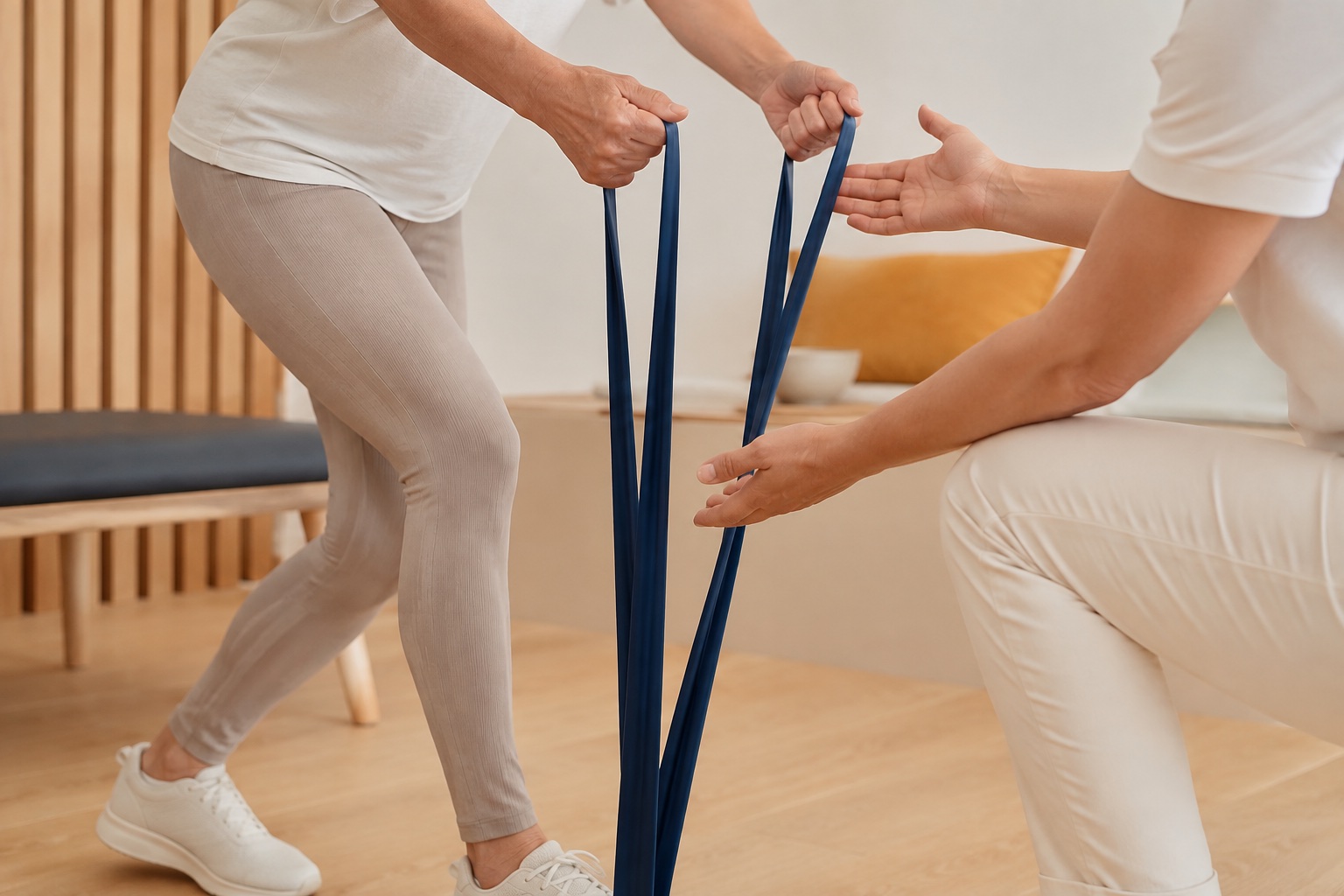
Exercise can then be modified in many ways. We can change the amount of resistance, the distance moved, the speed of movement, the number of repetitions, how long an activity is performed, how often it is completed, the position of the body, the amount of support available and the recovery between efforts.
For example, someone who cannot initially tolerate repeated standing exercise may be able to perform an upper-body conditioning exercise while seated. Someone who finds a full squat threatening or painful may begin within a smaller range. A person rebuilding lifting capacity may start with a load well below their eventual work requirement and progressively increase it.
Specialised equipment can help us make those changes very precisely. In the Harmony Movement Studio, Keiser pneumatic resistance equipment allows resistance to be adjusted in small increments while maintaining controlled movement. Concept2 equipment can similarly allow us to manipulate duration, pace, resistance and recovery.
The equipment is useful because it gives us options—not because rehabilitation depends on a particular machine.
What should happen with pain during exercise?
There is no single pain score that determines whether an exercise session has been successful.
A mild increase in symptoms during or after activity can occur, particularly when someone is returning to exercise or doing something their body has not been accustomed to. International pain guidance recognises that exercise responses vary considerably between people and that some people with persistent pain experience a temporary increase in pain following exercise.
Instead of looking only at “How much does it hurt?”, we also consider whether the response is familiar and manageable, whether it continues to escalate as the exercise continues, whether it settles reasonably afterwards, whether recovery is becoming easier as the program progresses, and whether the person can still function later that day and the following day.
Context matters. A familiar increase in pain that settles may lead us to continue or make only a small adjustment. A large, prolonged or progressively worsening response may tell us that the dose was too high. New symptoms, a significant change in the pattern of symptoms or signs suggesting a new medical problem deserve a different response again.
The aim is neither to avoid every sensation nor to assume that every increase in pain is harmless.
When a flare-up happens
Progress with persistent pain is rarely perfectly linear.
Someone may be improving for several weeks and then experience an increase in symptoms after doing more at work, sleeping poorly, becoming unwell, increasing training too quickly—or sometimes without an obvious explanation.
A flare does not automatically mean that rehabilitation has failed or that all exercise should stop. Often the more useful response is to adjust the dose.
We might temporarily reduce resistance, range, duration or volume; increase recovery; change the exercise position; or substitute an activity that is better tolerated.
At Harmony we often think of this as swapping rather than stopping. That may mean exchanging a longer walk for several shorter walks, replacing a demanding lower-body exercise with an easier variation, or maintaining cardiovascular exercise using a seated Concept2 SkiErg when another activity is temporarily less tolerable.
The aim is to respond to the flare while preserving as much useful activity as possible.
At the same time, persistent pain should never become a reason to ignore meaningful clinical change. If symptoms are new, substantially different, unusually severe or accompanied by other concerning features, reassessment may be required.
Measuring more than pain
Pain matters. But pain intensity alone does not tell us whether rehabilitation is working.
We may also measure how much force someone can produce, how many times they can repeat a movement, how long they can maintain an activity, their balance, walking tolerance, cardiovascular capacity or ability to lift and carry.
A person may be making meaningful progress when they can complete an exercise more consistently, require less recovery afterwards, move with less guarding, attempt something they previously avoided or feel more confident managing a temporary increase in symptoms.
Ultimately, the most important measures are often connected to real life. These might include whether you can:
- walk around the shopping centre again;
- carry the groceries from the car;
- lift something from the floor;
- play with your children; or
- do these things more consistently and with greater confidence.
Building towards something meaningful
Exercise for persistent pain does not need to begin with an impressive workout. It needs to begin with something achievable and lead somewhere worthwhile.
Over time, a small supported movement may become an unsupported movement. A light resistance may become a heavier one. Five minutes of conditioning may become twenty. A controlled lifting exercise in the clinic may eventually become the repeated lifting required at work.
The progression should be guided by the person’s goals and response rather than by an arbitrary timetable.
There is good evidence that exercise can improve function and quality of life for many people living with persistent pain, although there is no single exercise type or dose that is best for everyone. Current guidance therefore emphasises exercise that takes account of the person’s individual needs, abilities and preferences.
That individualisation is central to what we do in the Harmony Movement Studio.
Our goal is not simply to get somebody exercising. It is to understand what they need to be able to do, establish where their capacity is today, and progressively build towards it.
When pain persists, progress may require patience, experimentation and occasional adjustment.
The goal is gradual, meaningful progress: doing more of what matters, with greater confidence in what your body can do.